About ISGS
Dean's Message
Welcome to Graduate School of Integrated Sciences for Global Society
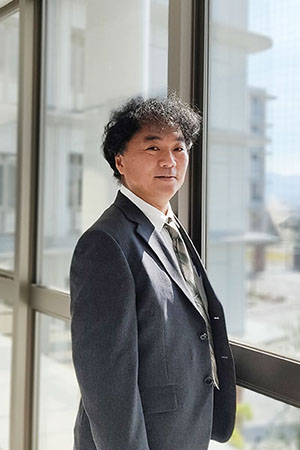
The world we live in today faces various issues such as pandemics, international conflicts, loss of biodiversity, and severe disasters caused by climate change. As an entomologist, the issue that concerns me most is the rapid loss of biodiversity.
Currently, it is estimated that more than 40,000 species are becoming extinct every year. There have been five mass extinctions in the history of the Earth. The current rate of species extinction is believed to be equivalent to the sixth mass extinction. Moreover, while the previous five mass extinctions were all caused by natural disasters, the reasons for the current sixth mass extinction are all human activities, such as habitat destruction, climate change, overexploitation, and invasive alien species. In other words, it is our actions that can change this situation.
However, halting biodiversity loss and finding ways for humans and nature to coexist is no easy task. For example, “development,” one of the main causes of biodiversity loss due to the destruction of habitats, also serves as the foundation for human economic activities and social life. For this reason, achieving a true balance between development and biodiversity conservation requires more than simply incorporating biodiversity conservation into development plans or implementing technical measures to minimize the impacts of development. It demands a fundamental transformation of society based on a new value system that moves away from a narrow focus on material wealth and instead pursues comprehensive well-being through harmonious coexistence with nature.
The loss of biodiversity, as well as the various global issues mentioned above, cannot be solved by short-term, technical solutions to individual academic fields or issues that have been emphasized in traditional university and graduate school education.
We need to acquire an attitude and way of thinking that allows us to approach issues from a long-term perspective and combine various methodologies.
In response to this, the Graduate School of Earth and Global Environmental Sciences has adopted “integrated interdisciplinary studies from a global perspective” as its educational philosophy and aims to nurture researchers and practitioners who possess both “advanced expertise” and the analytical and practical skills necessary to solve problems based on “multifaceted perspectives.”
As the only graduate school at Kyushu University that offers interdisciplinary education combining the arts and sciences, we award two degrees, one in academic studies and one in science, at both the master's and doctoral levels.
In addition, the Graduate School of Integrated Earth Sciences places great emphasis on fieldwork. Fieldwork involves going to an actual site, walking around, listening, observing, researching, and summarizing your findings on a given theme. When you actually visit a site, you often make various discoveries and see things you never imagined before.
As a first step toward deepening your understanding of biodiversity, I recommend that you first take a look at the natural environment and biodiversity around you. Japan has a natural environment and biodiversity that is extremely rich compared to any other region in the world. The Japanese archipelago, which stretches for about 3,500 km, is located across two major zoogeographical regions, the Palearctic and Oriental regions. In fact, the mountains and seas in Hokkaido in the north and Okinawa in the south are completely different, and the biota that inhabit these areas also differ greatly. There are also unique societies and cultures that have been strongly influenced by the natural environment of each region. I hope that international students will deepen their understanding of Japan, and that Japanese people will rediscover their own country, by traveling as much as possible and seeing the nature, organisms, societies, and cultures of various parts of Japan with their own eyes.
If you have the opportunity, please talk to the various people you meet on your travels. In the current situation, where complex and widespread changes are leading to social divisions on various levels, dialogue with various stakeholders and discussion from their perspectives is essential to reconnect people, organizations, and regions.
It is not theoretical knowledge gained from textbooks, but rather the hands-on experience gained through fieldwork that will undoubtedly be useful not only in addressing the loss of biodiversity but also in solving the various challenges facing modern society.
Let’s join the Graduate School of Integrated Sciences for Global Society to acquire the expertise in “interdisciplinary integration” and “fieldwork” and take on the complex issues facing current society.
Kunio Araya
Dean, Graduate School of Integrated Sciences for Global Society